The Spyro the Dragon series is easily one of my favorite platformers. I loved the quirky cast of characters and how the games evolved on the PlayStation 1. The series then moved to the PlayStation 2 and a new development studio, and things weren’t quite the same. I remember renting this game in late 2002 after I purchased my PS2 that summer. I didn’t play it much then, and soon forgot about the game. It wasn’t until later that I found out this game had notorious development issues. The studios that created it closed down right after the release of Spyro: Enter the Dragonfly and never made another game. All these years later, I decided to see if the game had some redeeming qualities or if it should remain on the shelf.
| Release Date | November 3, 2002 |
| Genre | Platformer |
| Platforms | PS2/GCN |
| ESRB Rating | Everyone |
| Players | 1 |
| Developer | Equinoxe Digital Entertainment, Check Six Studios |
| Price | $49.99 US |
Story
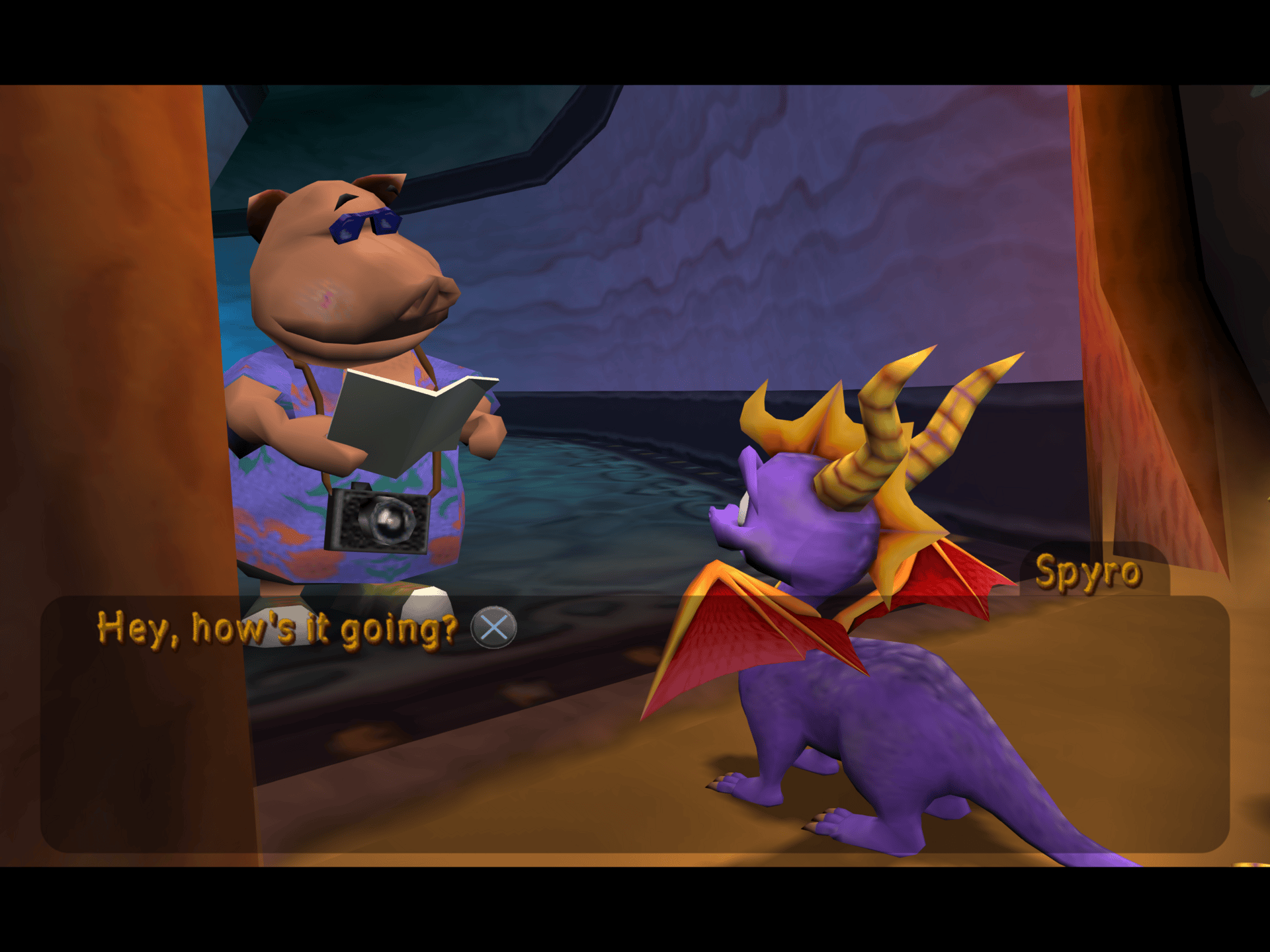
Spyro: Enter the Dragonfly loosely ties into Spyro: Year of the Dragon, with the dragon hatchlings being the eggs from YOTD. Each dragon is supposed to receive a dragonfly partner, but Ripto decides to disrupt this event. He pops in from a portal and tries to capture all the dragonflies to weaken the dragons. This backfires, and the dragonflies become scattered throughout the Dragon Realms. It’s up to Spyro to collect all the dragonflies with his new Bubble Breath ability.
Gameplay
Moveset
Spyro has a bit of an extended moveset in Enter the Dragonfly. In addition to his normal headbash, glide, and charge, he can also breathe fire, electricity, bubbles, and ice. These additional elements can only be unlocked by obtaining Dragon Runes as you play through the game. There’s even a new wing shield that will allow Spyro to bounce projectiles back at enemies. This is also unlocked through a Dragon Rune. I like the latest additions here, even if they aren’t very innovative. Spyro still moves every bit as well as in the PS1 games. The entire movement style can change when another studio takes on an existing franchise, so it was nice to see the feel stay the same.
Side Activities
There are plenty of side activities in Spyro: Enter the Dragonfly. Many of these activities occur in a vehicle, like keeping cows from being abducted by UFOs in your own UFO, shooting factories with a Spitfire plane, or destroying objects with a tank. There’s even a rhythm game where you have to keep a drummer’s beat, like Simon Says. There’s always something to find within the game’s nine levels, whether you’re racing a bumblebee or gliding through a time trial. Speaking of the time trials, these seem to be a bit more forgiving than in the original trilogy, as it never took me more than a couple of tries to hit the target time.
Collectibles
Much like previous Spyro games, Spyro is tasked with collecting different-colored gems in each level to complete the game 100 percent. That formula hasn’t changed in this game, and I was surprised that they didn’t add anything else to collect. There are occasionally some keys to collect to open locked chests, but that’s not something that is explored very heavily. Dragonflies are the main thing you’ll be collecting in the game, and they can be an annoyance when they fly away from you. I’m unsure why they would be flying away from someone trying to save them, but they do. There are ten dragonflies per level and 90 in the game.
Presentation
Graphics/Animation
I’m not going to say that Spyro: Enter The Dragonfly looks bad, but it does leave a lot to be desired. The textures are generally of low quality. You could say that about many early PS2 games, but this one looks like it was made on a very low budget. Spyro’s character model looks excellent, and his animations flow well. You can tell that a lot of care was put into the main character. The other characters in the game didn’t receive as much care. Characters will be looking into the distance, not even talking to Spyro during cutscenes. They bounce around and look lifeless more often than not. It’s a very mediocre game visually. It doesn’t help that the frame rate tanks unless you’re playing it on an emulator, which is the best way to play this game these days.

Level Design
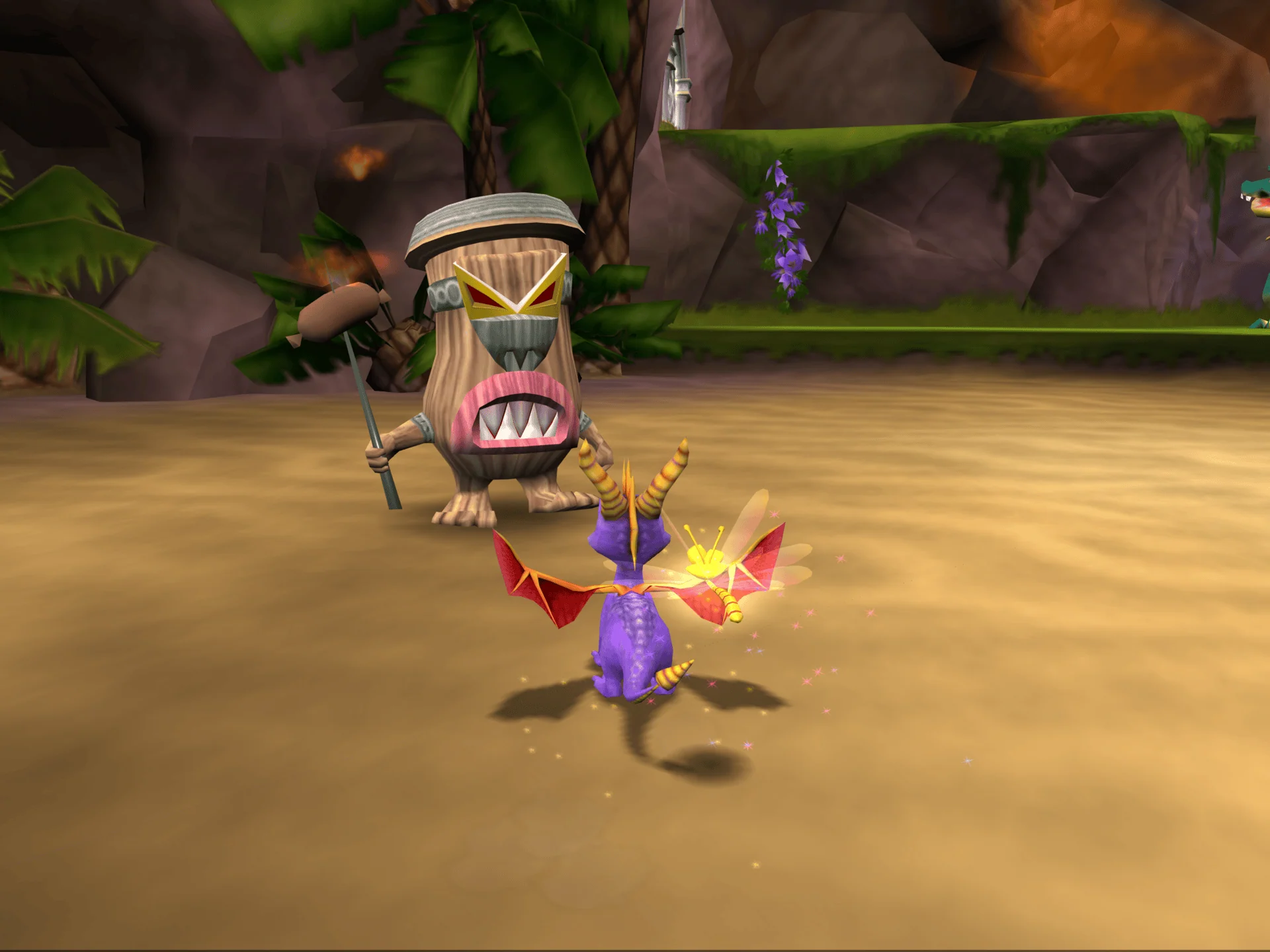
Enter the Dragonfly being rushed to market meant that we only got one hub world and a total of nine levels. I felt like the levels were inspired mainly by levels from previous Spyro games. There are monkeys, aliens, eastern architecture, clouds, honey, and even a tiki island. The levels were of varying lengths, with some feeling like they went on too long, while others felt like they breezed by. I think this speaks to the rushed development cycle. It almost seems like some of the levels weren’t quite finished, and they probably weren’t. The worst part is that the levels lack any density. There aren’t many puzzles or secrets to discover. You’re going from point A to point B and hitting a few challenge portals. I can only recall one level with some well-hidden gems.
Audio
The game’s soundtrack was one I enjoyed listening to all the way through. That is because it was composed by Stewart Copeland of The Police, who also composed the music to the original trilogy. The voice acting can be a bit rough at times, and it sounds like the actors were reading lines without context. It doesn’t help that the dialogue is abysmal. The worst part about the audio is when a sound replays constantly. It’s a glitch where you may only hear a seagull repeating over and over or a repetitive musical note. No matter what it is, it isn’t enjoyable. It happens pretty often, and I can’t get it to stop until I reset the game or move to a different area.

Conclusion
Spyro: Enter the Dragonfly is a perfect example of what happens when a game is rushed to market to meet a deadline. This is a game that had so much promise after such a fantastic original trilogy, and couldn’t live up to it. I still had fun during my playthrough, but it was so short and riddled with issues that it’s hard to recommend it to anyone. I’m just glad that this wasn’t the last we saw of Spyro and that they gave the character another chance.