The NHL series has endured many ups and downs throughout its long and storied history. I’ve been lucky enough to spend significant time with most of the titles in that series. I’m a huge hockey fan and always excited to see what EA offers when the next hockey season is upon us. There hasn’t been much to be excited about in recent years as this game has remained very similar since about NHL 21. Last year’s NHL 24 was a disaster on most accounts, even if they were laying the groundwork for the next few years of the series. That game was a buggy mess, leading to unnecessary penalties and game crashes in online modes. I’m happy to report that NHL 25 is a lot more polished and significantly improved over its predecessor despite some lingering online bugs.
| Release Date | October 4, 2024 |
| Genre | Sports |
| Platforms | PlayStation 5, Xbox Series S, Xbox Series X |
| ESRB Rating | Everyone 10+ |
| Players | 1-12 |
| Developer | EA Vancouver |
| Price | $59.99 US |
Gameplay
Skill-Based One-Timers
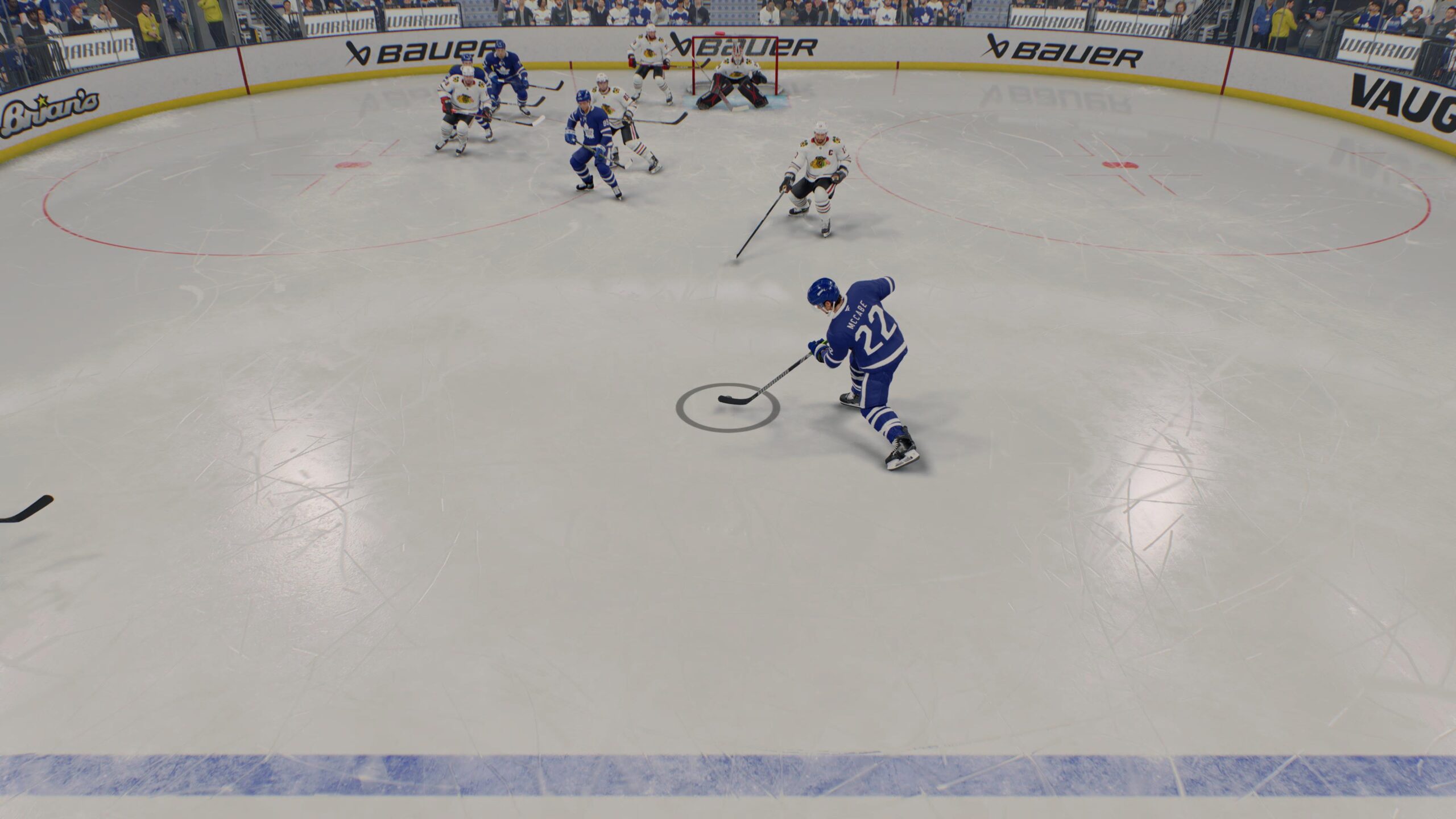
I will start this review by discussing the gameplay elements added and refined in NHL 25. The first addition is Skill-Based One-Timers, a significant change that has both benefits and drawbacks. In previous years, players could spam cross-crease one-timers, and the puck would go in the net nine times out of ten. Now, players must time their shots correctly to hit the net, aided by a visual target indicator that turns green when the shot is timed correctly and red if not. If you don’t time it right, the shot won’t be as hard, and the probability that it will miss the net increases. This mechanic works quite well for cross-crease one-timers, but ones from the point seem to be finding the net far too often. It is nice to blast a one-timer home with a point shot, as that has been difficult in past games, but it leans too far in the other direction now, and it’s starting to become a bit of an issue.
Next-Gen Vision Control
Next-Gen Vision Control is another significant feature that EA highlighted this year. It performs much better than Vision Control has in the past. With a click of a button, your orientation changes to wherever the puck is. This allows your player to make a better poke check, check defensively, or face the net for a better one-timer offensively. It sounds like a small change, and it is, but it helps you make better plays when you’re in a bind. This control, combined with the new desperation movements where your player will try to make a last-second poke-check or slip around a teammate you’re about to run into, gives you much more control of your player and makes the gameplay much more fluid than last year.
Puck Physics
One thing I’ve noticed in NHL 25 is that the puck is much more lively than in past games. I’ve seen this when I’ve played goalie over and over again. Many pucks that stick underneath the goaltender tend to start rolling or dribbling through until you cover them up. More five-hole goals are being scored this year, and more goals are finding holes through the goalie’s arm. This can be both good and bad as goals seem easier to come by than ever, but they’re also easier to defend than ever, so it evens out. It feels like real hockey, where if you’re positioned correctly and not giving the other team good opportunities, they’ll have a hard time scoring. The glitch goals are at a minimum this year unless you’re giving up breakaways, in which the goalies seem particularly susceptible to the Close Quarters X-Factor.

AI
The AI has seen a complete overhaul and is vastly improved over the previous game. Last year, the AI players were utterly useless in most situations. They had no idea where they were going or how to shoot the puck at the net. This year, they have a pretty lethal shot if they’re left around the net or have a breakaway. I was utterly shocked when a CPU player had a breakaway and deked to put the puck in the net, much like a human would. They set up well in the offensive zone and do a good job getting to open ice. On the defensive side, they’re very tough in front of the net and don’t give up a lot of space. The one issue I’ve noticed with them is that they still struggle with speed when backing up on defense. The goalie AI is still pretty hit-and-miss, with many basic dekes beating them while they flash the leather on more advanced moves.
Time and Space
This year’s gameplay is slowed down compared to NHL 24, which is for the better. Your team can set up a Power Play and make the tic-tac-toe passing plays you’ve always dreamed of making with great precision. It doesn’t feel like everyone picks the fastest skater, and that’s all that matters now. Every type of build matters, and every player has their place. It feels like a genuine hockey game now, more than an arcade experience, unlike in the past five years or so. It’s not perfect, but EA is taking this game in the right direction for die-hard hockey fans while still catering to newcomers to the series with the on-ice trainer. It’s the best on-ice game since 2014, and that says a lot because NHL 14 was one of my top-3 favorite NHL games.
Graphics
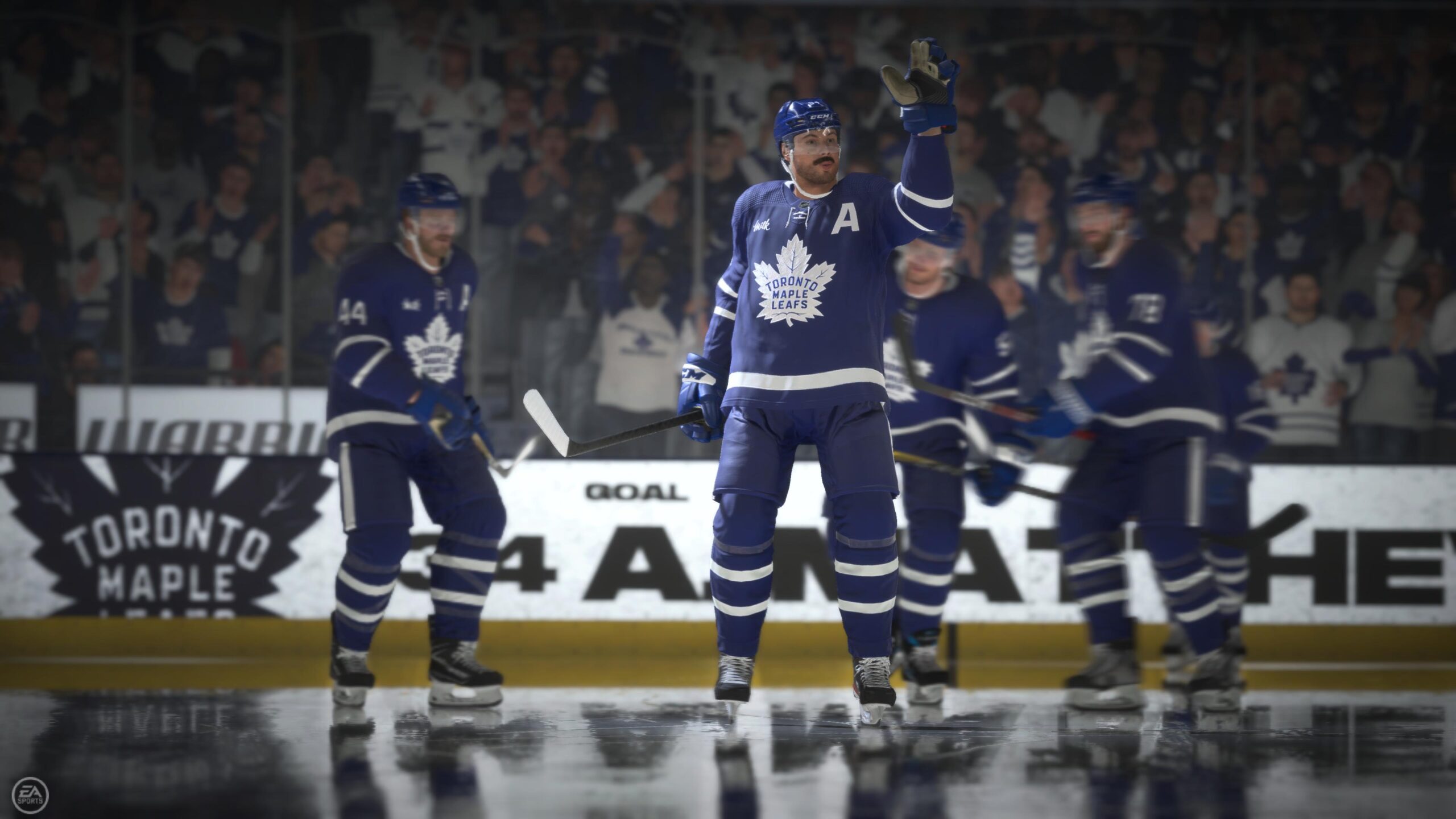
This is the first game built specifically for the current generation of consoles, and it shows on the visual side. The player models look better than ever, particularly in terms of their hair. For so many years, the hair in this game has looked terrible, but it finally looks and flows realistically, which is a welcome change. Animations look smoother, faces look more lifelike, and the lighting and reflections are as realistic as we’ve seen in a hockey game. The oddity I found is the amount of snow on the player’s pants, which, while cool, is pretty unrealistic. You could start a period and have a cutscene where your player has snow all over the front of their pants and leggings, which seems a bit overboard. I’m nitpicking here, but it became a source of comedy for our team when we first noticed it.

Game Modes
Franchise Mode
Franchise Mode is the only mode that received meaningful changes this year. This will be music to many players’ ears, as Franchise hasn’t changed much in the last five years or so. The first notable change is the hub menu, which consolidates most of the necessary information and presents it directly to you. You’ll no longer have to flip through menus to find the options and stats you’re looking for.
The second new addition to Franchise Mode is the conversation system from Be A Pro Mode. I’m not a massive fan of this system in Be A Pro, but I think it works more effectively in Franchise Mode. If a player isn’t interested in signing with your team, you’ll have to convince them to sign. You can offer them different incentives, such as first-line minutes or adding a no-movement clause to their contract, a new addition this year. GMs can also discuss with the head coach what the team should focus on during the off-season. This will unlock various perks or detriments for the team, depending on the outcome. You can even have conversations with individual players to aid in their development by assigning them personal goals, for which they will obtain an X-Factor perk for completing the goal.
Be a Pro
Be A Pro mode remains unchanged this year. It’s pretty much the same thing this year as it has been in the past few years. I imagine the next overhaul will be coming in NHL 26. Sadly, offline players don’t have any real reason to upgrade if this is their only mode. It would be nice if you could import last year’s save into NHL 25 to continue your career in this year’s game. You don’t get that. You restart the same arc every year. There’s just no incentive to do it other than the same handful of tedious trophies/achievements.
Hockey Ultimate Team and World of Chel
Hockey Ultimate Team is the only other mode that gets any meaningful tweaks. There is a streamlined XP progression track now that should have always been there. A Wildcard mode allows you to draft your team based on unique criteria like salary cap or overall ratings. It wasn’t enough to make me care more about HUT than usual. I’m sure plenty of people out there will, though. World of Chel received some quality-of-life improvements, such as copying equipment setups across home, away, and alternate worlds, but nothing else was notable.

Issues
I have encountered some bugs during my playtime in the game. One issue is that the wrong replay shows, such as a goal after a penalty or the opposite team’s goal, for what should be your goal. It’s weird and annoying. We’ve also had players drop out of our party during the pre-game in WoC a few times. The worst bug was when our goalie covered the puck and then pulled it into the net and out the other side, giving the opposing team the win. There’s another weird one where the graphics appear on the screen, and the faceoff has already started. That seems to happen occasionally. Nothing is too significant like last year, but these are the notable ones.
Final Thoughts
NHL 25 isn’t the massive leap everyone has been clamoring for since the PS3 generation, but it is a great hockey game. The gameplay and visuals in this game are better than they’ve been in a very long time. I’ve had a lot of fun with the game. The small gameplay changes have significant ramifications for how this game plays. If you’re coming from 24, you will notice a considerable difference. It’s well worth the upgrade, even if the game modes still haven’t received much love outside Franchise Mode.